Posts

Showing posts matching the search for content

Content-Based Application of Content-Neutral Speech Restrictions

by Michael Dorf In my latest Verdict column , I discuss a recent ruling by a federal district court striking down an Idaho "Ag-Gag" law--i.e., a law forbidding, among other things, gaining access to an agricultural facility under false pretenses as well as recording what happens there without government authorization or permission of the facility's owner. As I explain in the column, although the immediate context of the case is a victory for animal welfare* investigators, it has potentially far-reaching consequences for investigative journalists and activists much more broadly. In this post, I'll address an ambiguity in free speech doctrine concerning the implications of the ruling. As I note in the column, the main thrust of the opinion is that Idaho's law is content-based and therefore must be subject to strict scrutiny, which it fails: Idaho lacks a compelling reason for singling out investigators of farms for restrictions on speech. But in this as in othe...
Pending Congressional Revision of Section 230, Courts Should Treat it Like the Sherman Act

by Michael C. Dorf In 2021, a panel of the U.S. Court of Appeals for the Ninth Circuit construed Section 230 of the Communications Decency Act  mostly to shield major internet companies from civil liability to the families of victims of ISIS murders. The plaintiffs alleged that the algorithms of Facebook, YouTube, and Twitter promoted ISIS content, thus rendering them liable under the civil liability provision of the Anti-Terrorism Act (ATA) . On Tuesday and yesterday of this week, the Supreme Court heard oral arguments in the two cases that seek reversal of the Ninth Circuit decision. Why two cases? Because the Ninth Circuit decision reached a split decision.  It approved one district court's determination that Section 230 provides a shield but reversed another district court's dismissal of the complaint on the ground that it failed to state an ATA claim. Accordingly, in Tuesday's argument in Gonzalez v. Google , the plaintiffs appealed, arguing that Section 230 should no...

Should Media Companies Remove Old Content Featuring or Made by Sex Offenders and Other Wrongdoers?

by Michael Dorf In light of the revelations and accusations that Kevin Spacey sexually harassed and/or assaulted various men and boys over the years, Netflix has suspended production of the upcoming season of House of Cards , in which Spacey has hitherto starred. Reportedly, the show's writers are attempting to write Spacey's character, Francis Underwood, out of the show. In the meantime, Netflix subscribers can still watch the existing five seasons. That is more than can be said for fans of comedian Louis CK, who admitted late last week that he had pressured women to view him naked. Women have alleged that CK masturbated in front of them; CK's apology  admits that he "showed them" his penis but does not specifically mention masturbating. In any event, the incompleteness of CK's apology does not seem to be at issue, because HBO acted before CK published it. Within a day of the initial revelations, HBO canceled upcoming projects with CK and also pulled CK...

Free Speech for Robocallers? A Preview of the Severability Issue in Barr v. American Ass'n of Political Consultants

by Michael C. Dorf Listeners tuning in live to hear Supreme Court telephonic oral arguments today will likely be most keenly interested in the cases involving claims at the intersection of religious freedom and what's left of the Affordable Care Act's employer-mandated contraception coverage. But there's another case to be argued today, Barr v. American Ass'n of Political Consultants  (AAPC) , and it involves the free speech rights of robots! As longtime readers know, I favor rights for sentient robots on the same grounds that I favor animal rights, so you can imagine how excited I am to see the possibility of robots getting their due in the highest court in the land. Okay, fine. AAPC has nothing to do with the rights of robots. It's a case about the rights of robocallers--that is to say, the human beings who want to send pre-recorded or auto-dialed messages to mobile phone users. That's right, this is a case brought by perhaps the least popular demographic in...

Do Elon Musk's Antics Show that--Gasp!!--Justice Alito had a Point in the Netchoice Case?

Much of the ruling and the focus of the various separate opinions in the Supreme Court's ruling last month in Moody v. Netchoice concerned a technical question: whether Netchoice had made a sufficient showing to satisfy the standard for evaluating a facial challenge to a law. The Court held that neither the Fifth Circuit--in evaluating Texas's law regulating social media platforms' content moderation--nor the Eleventh Circuit--in evaluating Florida's similar law--had applied the correct standard and therefore sent the cases back down for further proceedings. But Justice Kagan's majority opinion also decided that content moderation by a social media platform is protected speech akin to the editorial discretion a newspaper exercises in deciding what letters to the editor or, for that matter, what stories, to publish. Justice Kagan wrote: When the platforms use their Standards and Guidelines to decide which third-party content those feeds will display, or how the disp...

Disagreeing to Agree on Recess Appointments and Buffer Zones

by Michael Dorf The Supreme Court "unanimously" decided two cases today. In NLRB v. Noel Canning , the Court invalidated President Obama's use of the recess appointment power while the Senate was in pro forma session. In  McCullen v. Coakley , the Court invalidated the Massachusetts 35-foot buffer zone around entrances to facilities (other than hospitals) where abortions are performed. I put "unanimously" in quotation marks above because each case produced a 5-4 split with a heated concurrence in the judgment that read more like a dissent. Thus, in both cases, the majority consisted of the four liberals plus one of the two slightly less conservative conservatives. In Noel Canning , Justice Kennedy joined the majority opinion of Justice Breyer and in McCullen , CJ Roberts reprised his role from the 2012 Health Care Case , writing a majority opinion joined by the liberals.   (In McCullen , Justice Alito wrote his own concurrence in the judgment rather than joi...

Is Antidiscrimination Law Content-Neutral?

 My latest Verdict column is titled Advice to Campus Administrators: Don’t Call it an "Expressive Activities Policy," Except to the Extent that Expressive Activities Receive Extra Solicitude . In it, I discuss the "Expressive Activities Policies" adopted by or under consideration at various colleges and universities around the country. I explain that such policies typically read as regulations of expressive activities but that this framing is at best misleading. It suggests that colleges and universities are adopting restrictions on expressive activities in particular. Instead, they should be understood as applying their general rules of conduct to all activities, including those that happen to be expressive. Thus, a college or university has the same interest in forbidding an impromptu game of ultimate frisbee on its main quad if that poses a danger to safety or access to buildings as it does in forbidding an impromptu march or rally. Permissible content-neutral ti...

Does TikTok Have a First Amendment Defense to the State Lawsuits?

Yesterday, the Attorneys General of thirteen states and the District of Columbia each filed a separate lawsuit against TikTok . As readers no doubt know, a federal law requires ByteDance to sell TikTok or to cease operations in the U.S. TikTok is currently suing to enjoin the enforcement of that federal law, but based on the oral argument in the D.C. Circuit last month, it looks unlikely to prevail. The state suits are not entirely overkill, however, because they seek monetary as well as injunctive relief, so they could go forward even if TikTok ceases operations in the U.S. The federal government's defense against TikTok's free speech claim is that Congress has not targeted TikTok because of opposition to the content on its platform but because of national security concerns. Much of the evidence for the conclusion that TikTok, as a Chinese-owned company, poses a national security risk, is not available to the public, so it's difficult for someone (like me) who has not see...

Content

By Mike Dorf Monday's decision in Holder v. Humanitarian Law Project  (HLP)  is, of course, most notable for upholding the federal "material support" statute against a First Amendment challenge, but in the course of getting to that result, the majority opinion by CJ Roberts says some things about free speech doctrine more generally that will likely have the effect of broadening protection for free speech. A threshold point of contention was whether the law should be judged as content-based (and thus subject to strict scrutiny) or content-neutral (and thus subject to what is nominally intermediate scrutiny but under the SCOTUS precedents amounts to a test that is fairly easy to meet).  The government argued that the law should be deemed content-neutral because it is a regulation of conduct--here, material support--that is often non-expressive (e.g., providing money, goods, or services to a terrorist organization) and only happens to be expressive in this particular c...

The Right to Lie

By Mike Dorf With so much attention being paid to the Supreme Court's Affordable Care Act decision last week, it was easy to overlook another ruling--that the Stolen Valor Act violates the First Amendment. In United States v. Alvarez , the Court invalidated an act of Congress that made it a crime to falsely claim that one is a decorated war hero. (The particular case involved a knowingly false claim that that speaker had been awarded the Congressional Medal of Honor.) To my mind, the plurality opinion (authored by Justice Kennedy and joined by Chief Justice Roberts, Justice Ginsburg, and Justice Sotomayor) gets it just about right: There is no pre-existing category of unprotected speech comprising false statements of military valor; United States v. Stevens sets an extraordinarily high threshold for the creation of new categories of unprotected speech; there is no way to squeeze the statute into any of the existing categories of unprotected false speech; therefore the law m...

How Do We Defeat Demagogues?

by Neil H. Buchanan Demagoguery is hardly a new problem.  Even so, it waxes and wanes in different places at different times, and the political right in the United States is now in the midst of a full-on embrace of the worst excesses of demagogic hate-mongering.  Can it be defeated?  Not completely, of course, but it should be possible to minimize its damage and send it back into hibernation. I hope that that is true, in any case.  The problem with demagogues is not merely that they can convince surprising numbers of people to believe harmful nonsense in order to win votes.  The worst kinds of demagogues parlay their initial success by abusing their power in ways that will make them immune to future challenges.  Some demagogues are so popular that the public largely supports their efforts to subvert the political system.  Even they, however, are risk-averse enough to lock down the system to protect themselves from any changes in public sentiment -- no...

The Perversely Fascinating Ted Cruz (It's Not About Cancun)

by Neil H. Buchanan For someone possessing whatever is the opposite of charisma ( repellency , maybe?), Ted Cruz has made it very far in life.  Cruz, moreover, has succeeded not in one of the areas in which being a jerk can be a positive, which is what allows Martin Shkrelli or Elon Musk or Roseanne Barr to enjoy at least temporary success.  No, he actually has somehow convinced millions of people to vote for him on multiple occasions. That is not, of course, as uncommon as I made it seem just now.  There are plenty of politicians of national stature who are simply awful personally, from former Democratic congressman Barney Frank and still-Governor-for-now of New York Andrew Cuomo to Senator Rand Paul or the late Senator Strom Thurmond.  For as long as there have been parties, and especially in current Republican politics, winning general elections is not the real game.  All Cruz had to do was work behind the scenes to grab his party's nomination and, in a stat...

What's Wrong, But Also What's Right, About the District Court Ruling Invalidating Pennsylvania's Public Health Measures

  by Michael C. Dorf On Monday, Federal District Judge William Stickman IV ruled that public health actions by Pennsylvania Governor Thomas Wolf--most centrally a stay-at-home order and business closures during the most acute phase of the COVID-19 pandemic--were unconstitutional infringements on liberty and, in one instance, a denial of equal protection. The ruling in County of Butler v. Wolf  generated considerable news coverage, much of it in a partisan frame: a Trump-appointed judge who was confirmed on a close-to-party-line vote seemed to say that the arch-conservative 1905 decision in Lochner v. NY remains good law, and in so doing vindicated GOP resistance to coronavirus-fighting measures by a Democratic governor. I have good news and bad news. The good news is that the opinion is more thoughtful and well-reasoned than it has been portrayed. The bad news is that it is nonetheless wrong on a number of key points. In this essay, I'll first describe what Judge Stickman get...

Lessons From Milbank's Non-Censorship of Harvard Student Speech

by Michael Dorf An "Open Letter to the Law School Community " from various law students and legal scholars expresses concern about the Milbank law firm 's withdrawal of funding for student activities at Harvard Law School following complaints to the firm that the firm's name appeared as a funder of an event at which controversial positions were going to be espoused. I share the view of the signers of the Open Letter that outside funders should not be able to use financial leverage to stifle free speech on campus. I also have great respect for many of the Open Letter's signers, including various of my current and former distinguished colleagues. Nonetheless, I think the letter incorrectly describes Milbank's actions as tantamount to censorship. I'll begin with a very brief summary of the facts as described in stories in the Harvard Crimson and New York Times . In 2012, Milbank pledged to give HLS $200k/year for five years to support various student act...

An Online Place

by Diane Klein Suppose the faculty, staff, and students at nearly every institution of higher learning in the United States woke up tomorrow in the plot of "A Quiet Place."  Terrible fatal monsters were stalking their schools, sensitive to the very least sound.  In response, university administrations ordered everyone to begin using American Sign Language (ASL) for all instructional activities, immediately.

SCOTUS Crisis Pregnancy Center Case Shows Originalist Justices Are Originalist Except When They're Not

by Michael C. Dorf Today's decision in National Institute of Family Life Advocates  (NIFLA)  v. Becerra   was ironic in at least one respect. The Court applied strict scrutiny to California's law requiring so-called crisis pregnancy centers to post information regarding abortion options because of a broad understanding of what renders a law content-based. And yet readers of the Court's opinion could be excused for thinking that the decision itself was content-based. The Court divided 5-4 on ideological grounds, with Justice Thomas writing the majority opinion for himself and the four conservatives. Yet some of the dissenters (the Court's liberal-leaning justices) are, in other contexts, more protective of free speech than some of the majority. It thus looked very much like the reason for the Court's robust protection for free speech here was the subject matter or content of the speech regulation: abortion. (Justice Kennedy is a possible exception to this observa...

What NBA Commissioner Adam Silver Doesn't Get About National Anthem Protests

Image
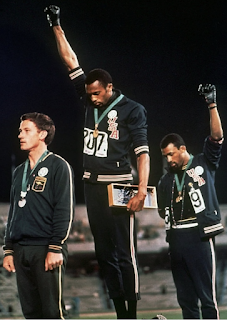
by Michael Dorf With preseason basketball now underway and the regular season set to begin in just over two weeks, the NBA may soon have to decide what to do if any players take a knee or register some other protest during the pre-game playing of the national anthem. Last week, NBA Commissioner Adam Silver noted that NBA rules require players, coaches, and trainers to "stand and line up in a dignified posture" during the playing of the national anthem. Silver has declined to say what discipline, if any, will be imposed on players (or coaches or trainers) who break the rule. But his explanation of his expectation that they will comply betrays a basic misunderstanding of principles of free speech.

A Tempting, but False, Both-Sides Angle to the Republicans' Culture War Against Critical Race Theory

by Neil H. Buchanan Republican legislatures across the country are frantically rushing through legislation banning the teaching of Critical Race Theory (CRT) in schools and colleges.  Several states have already adopted such laws, and more will soon join them.  In a recent column here on Dorf on Law , I critiqued Oklahoma's new law and concluded that it was likely to have its intended chilling effect on discussions of race in that state's classrooms, even though it could counterintuitively be used by clever instructors to increase the discussion of systemic racism in universities and schools. Professor Dorf's column yesterday described this as "sidelash," a neologism that he defines as "reaction against gains made in another jurisdiction by a social/political movement that seeks change" (emphasis in original).  That is, the states in which Republicans are passing these laws are not the states in which CRT is likely to have much impact on the local pop...

Ahmadinejad, Again

My last post on the Ahmadinejad visit to Columbia generated some very heated debate, which I won't join. Instead, I'll take another crack at some of the free speech/academic freedom issues. A number of the comments on my last post, and a great many more comments in other fora, refer to the invitation extended to Ahmadinejad by Columbia . This is not exactly false but not exactly true, either. Ahmadinejad sought the invitation to speak at Columbia through Professor Richard Bulliet of Columbia's Middle East Institute. The invitation was ultimately extended by John Coatsworth, the Acting Dean of the School of International and Public Affairs, who says: " Opportunities to hear, challenge, and learn from controversial speakers of different views are central to the education and training of students for citizenship in a shrinking and dangerous world." It now appears that President Lee Bollinger will introduce Ahmadinejad, and challenge him on his Holocaust denial,...