Posts

With Amici Like These . . .

Image
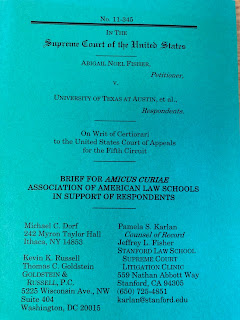
by Michael C. Dorf On Thursday of last week, the Supreme Court issued official guidance regarding the filing of amicus briefs. Most of it simply collects what's already in Supreme Court Rule 37, but even so it's useful. For a summary of the guidance (which is itself pretty short), here's a helpful article on Bloomberg. I'll offer some critical thoughts on a couple of points: (1) party consent; and (2) colors.

Must the US and Other NATO Members Aid Turkey if Syria Counter-Attacks?

by Michael C. Dorf Numerous commentators (including yours truly ) have condemned President Trump's precipitous withdrawal of US forces from northern Syria as a betrayal of our erstwhile Kurdish allies. It was and remains such a betrayal. Despite yesterday's announcement of a 5-day "pause" in operations--which was predictably and inaccurately hyped by Trump as a "great" deal that resulted from his "tough love"--Turkey apparently has no current plans to withdraw forces from its self-declared "safe zone" in northern Syria. Thus, Turkey's incursion leaves alive the possibility of clashes between Turkish and Syrian and/or Russian troops. Such clashes in turn might result in a call for NATO involvement. Suppose Syria crosses the border and counterattacks. Suppose Russia, which has troops stationed in Syria about 20 miles south of the Turkish border, assists in such a counterattack. Would that constitute an "armed attack" under...

Buttigieg Jumps the Shark

by Neil H. Buchanan Pete Buttigieg, it turns out, is a bit of a dick.  This was not supposed to be his brand.  He presented himself to the world as a thoughtful, modest uniter with Midwestern quietude and restraint who would move our politics forward -- the avatar of a new generation of people who have had enough of the old ways of doing things.  We wanted to like him.   I certainly wanted to like him. Apparently, however, Buttigieg decided that this was no longer working.  It seems that his initial success in moving into the second tier of candidates who might  break through -- not among the Three Septuagenarians leading the pack, but also clearly in a different category from Cory Booker and Amy Klobuchar -- gave him a taste for more.  Unfortunately for him, his boomlet ran its course as he faded out of double digits in national polls and has been muddling along in a land where people assume his future is as a Vice Presidential pick. How to...

The Costs and Benefits of Economic Sanctions

by Michael C. Dorf It is better to be shocked with a taser than shot with a gun, but a shock from a taser is nonetheless extremely unpleasant. So too with economic sanctions, which unleash less destructive force than armed conflict but nonetheless can be nasty. I'll explore the point today with reference to Trump policies and the current controversy embroiling the National Basketball Association.

Tramp the Dirt Down

by Neil H. Buchanan As the world tries to understand why Republicans have not abandoned Donald Trump, despite his violation of so many of their supposed principles -- Hint: It cannot be that he "does what conservatives want him to do" (and certainly not only that), because any Republican president would be substantively identical to Trump on taxes, the environment, labor law, and so on -- it is worth remembering once again that many of those principles themselves are indefensible. And understanding what makes the modern conservative movement indefensible in turn calls for us to remember that the same symbiosis that currently exists between the US and UK in their political malfunctions (Brexit simply being Trumpism carried out by a number of mini-Trumps rather than one mega-corrupt Trump) existed at the onset of what American Republicans think of as the dawn of a new day under Ronald Reagan when he took office in 1981. I am referring, of course, to Margaret Thatcher, wh...

Justice Neil Gorsuch: Hubris Masquerading as Modesty

By Eric Segall Last Tuesday, the Supreme Court heard three cases raising the issue whether Title VII of the Civil Rights Act of 1964, which prohibits employment discrimination "on the basis of sex," protects gays, lesbians, and transgender persons. During the oral argument , Justice Neil Gorsuch conceded that the textual issues were very close and then asked Professor David Cole, one of the plaintiffs' attorneys, whether a judge should "take into consideration the massive social upheaval that would be entailed in such a decision, and the possibility that -- that Congress didn't think about it ...  That's it. It's a question of judicial modesty." This paen to "judicial modesty" is consistent with many passages in Gorsuch's new book, "A Republic If You Can Keep It," which I reviewed here . For example, in that book, Gorsuch says he has two rules for his law clerks: 1) "Don't make stuff up," and 2) " When p...
House Impeachment Procedures

by Michael C. Dorf Let's begin with what's clear. 1) Congress has the power to subpoena private citizens and past and present executive branch officials to testify and to produce documents so long as the witnesses and materials sought bear some rational relationship to a legitimate congressional purpose, including impeachment and potential legislation. The Trump administration's withholding of appropriated funds from Ukraine makes the present impeachment inquiry obviously relevant to Congress's power of the purse. So too, Trump's conduct--as indicated by his own statements--makes the inquiry relevant to consideration of impeachment. Absent identification of specific objections on national security, particularized executive privilege, or other pressing grounds, executive branch officials and private parties must comply with congressional subpoenas. A court has rightly rejected Trump's claim to the contrary in litigation over Trump's financial records. Lik...

Athletics and College Admissions at Harvard and Beyond

by Michael C. Dorf Last week, Federal District Judge Allison Burroughs issued a 130-page opinion  rejecting a challenge to Harvard College's admissions program. The lawsuit on behalf of Students for Fair Admissions charged that Harvard discriminates against Asian American applicants in violation of Title VI. Because the Supreme Court has construed the prohibition on racial discrimination in Title VI as coextensive with the Fourteenth Amendment's Equal Protection Clause, the ruling in the case has implications for public as well as private colleges and universities--assuming it stands up on appeal. Much of the press coverage of the Harvard case has treated it as a test of the legality of race-based affirmative action. And indeed, it may prove to be that. Although Judge Burroughs applied existing SCOTUS case law allowing the consideration of race as a plus factor but not a quota and allowing colleges to seek diversity but not racial balancing, the most recent articulation of ...

I Know It's Really U.S. Cultural Imperialism, But I Like It

by Neil H. Buchanan I suppose that, in early 1933, there must have been intellectuals scattered about the world thinking about relatively lightweight topics like popular music.  They surely knew that important things were afoot politically, especially in Germany, but they likely had no idea that the Reichstag fire was imminent.  Today, at least we have reason to know that something like that is all too possible. Wikipedia helpfully explains that "[t]he term 'Reichstag fire' has come to refer to false flag actions facilitated by an authority to promote their own interests through popular approval of retribution or retraction of civil rights."  Today, as Donald Trump's political nightmare deepens and he becomes increasingly untethered to even his abnormal version of normal day-to-day behavior, it seems more than reasonable to wonder what extreme and desperate measures he will take to save himself. Groups of his supporters -- possibly even including so...

The Way to Stop the Title VII Parade of Horribles is to Stop Parading the Horribles

by Michael C. Dorf Today the SCOTUS will hear oral argument in two cases apparently presenting the questions whether Title VII's prohibition on sex discrimination thereby forbids discrimination based on sexual orientation and gender identity. As Prof  Marty Lederman explained in a blog post last month, the framing of the cases as involving categorical policies excluding LGBT persons from employment is wrong on the facts, but he also argued (and I agree) that if the cases are framed that way the plaintiffs still should win. (Interested readers can find the brief by Marty, me, and three other law professors in support of plaintiff Aimee Stephens in the  Harris Funeral Homes case here ). Today I want to address two arguments made against recognizing gender identity discrimination as sex discrimination. Both have the flavor of a parade of horribles and feature in various briefs by the defendants and their amici. The arguments are that if gender identity discrimination is deem...